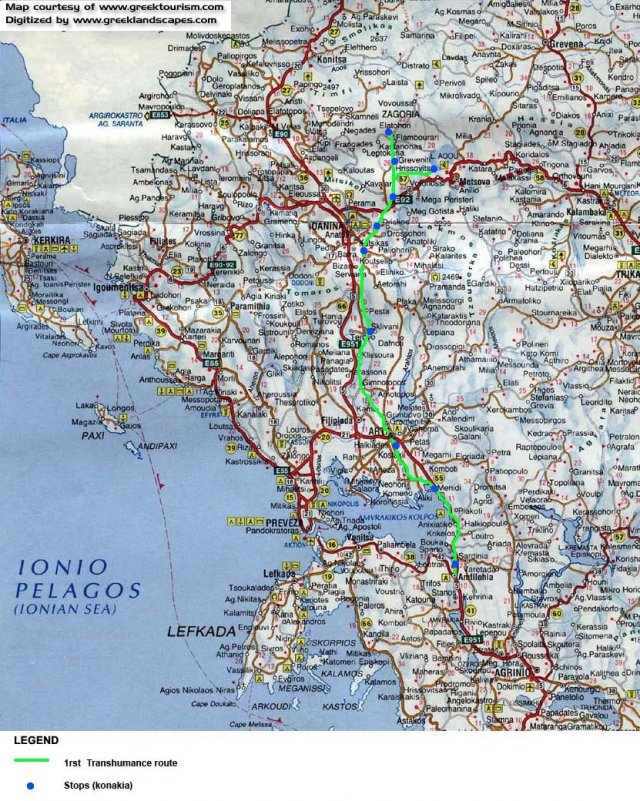
1st transhumance route used from the Sarakatsani of Epirus:Αitoloakarnania-Zagoria |
Visual or audio material of objects, buildings and constructions, processes |
 |
|
|
Description accompanying the visual/audio material
- Chronology
This transhumance route was kept till the 1970. Nowadays the flocks are transported by tracks and the shepherds are taking the national highway.
- Country
GREECE
- Heritage Theme
Transhumance routes
- Location
This route is located at Sterea Ellada and Epirus. - History
Until the 19th century stockbreeding in Greece was almost entirely nomadic. Descendants of those stockbreeders, who once flooded the mountains and plains with their flocks, continue even today to follow the age-old habits of going up and down every winter and summer to winter pastures and summer meadows, respectively. This type of sheep raising involves the transfer of the sheep in the highlands around St. George Day in April, where they spend the rest of spring and summer, and their return to the warmer lowlands near St. Demetrious Day in October to spend the winter. The main residence of the shepherds is in the lowlands; while in the summer grazing fields they keep either permanent or temporary structures. Due to the need for cheese production in the summertime as well, it was common to develop cheese-making facilities.
|
- Description of function, materials, style, shape
The itinerary is described by the stops (konakia), where all the activities were taking place (milking the sheep, preparing the food, resting and negotiating the prices of milk and dairy products with the merchants of nearby villages and towns).
1st konaki: “Paliavli (Παλυαυλή). Αrea nearby the town of Amfilohia in the county of Aitoloakarnania. The Sarakatsani were arriving in the afternoon for the 1st milking of sheep. During the night they were living and were crossing the mountain called “Makrynoros” (Μακρυνόρος).
2nd konaki: Κoprena (Kόπραινα). Αrea of Arta’s prefecture. Milking in early morning.
3d konaki: Hanopoulo (Χανόπουλο). Nearby the town of Arta. They were passing the night. Milking night and early morning.
4th konaki: Sklivani (Σκλίβανη). Αrea of Ioannina prefecture. They were passing the night.
5th konaki: Harokopio (Χαροκόπιο). At the outskirts of the old airport of the city of Ioannina. They were staying for 1-2 days, in order to sell their dairy products and to shop various goods. The shepherds during their journey were making cheese. Driskos mountain, they were stopping temporarily in order milk their sheep.
6th konaki: River Grevenitiko, Tsipianis’ bridge, was their 6th konaki
7th konaki: Elatohori (Ελατοχώρι), in the area of Plaka or nearby the lake of the Aoos river, was the 7th and last stop (konaki), where the shephers were spending the summer.
|
- Bibliography
Braudel, F. (1994). La Mediterranee, l’ espace et l’ histoire”, Paris 1977. Enquete “SOS Transhumance”. Paris: Musee Dauphinois.
Fraternity of Epirotes Sarakatsani in Athens (2011).Sarakatsani. Course in place and time. Athens: Fraternity of Epirotes Sarakatsani in Athens.
Fraternity of Epirotes Sarakatsani in Athens (2009).Sarakatsana. Image and word. Ministry of Interior Decentralisation & E-government. General Secretariat for Gender Equality. Athens: Fraternity of Epirotes Sarakatsani in Athens.
Nitsiakos, B. (1995): The Mountain Communities of North Pindos: In the aftermath of Long Endurance, Athens, Plethron Press (in Greek).
http://en.wikipedia.org/wiki/Sarakatsani
http://www.sarakatsianoi.blogspot.com
http://sarakatsanoi-ip.gr
|
- Keywords
Transhumance route, the Sarakatsani of Epirus, Αitoloakarnania-Zagoria, konakia
|